GPS Tracking on Company Vehicles in Italy: When Authorization Is Required and the Correct Legal Process
Learn when GPS tracking on company vehicles is legal in Italy, when union agreement or INL authorization is required, and the GDPR steps to follow.
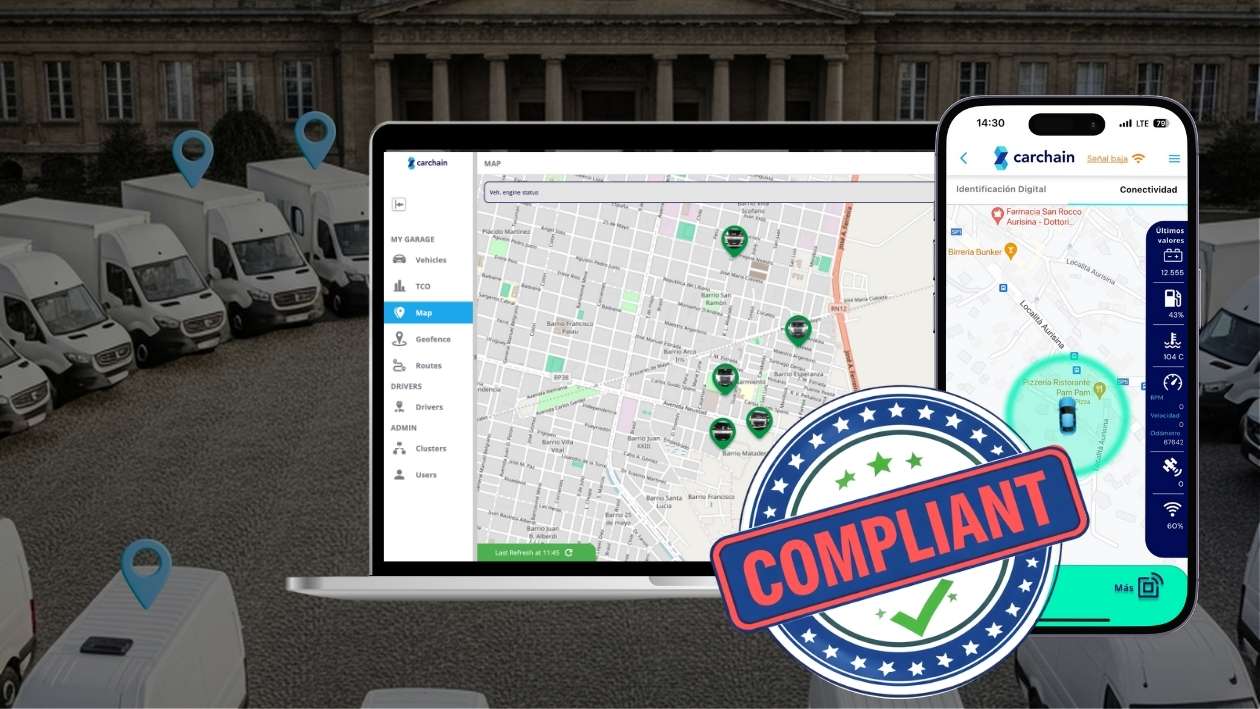
Installing GPS tracking devices on company cars and vans is increasingly common: it improves fleet safety, reduces costs, optimizes routes, and supports operational control.
However, in Italy, GPS tracking may become a form of indirect employee monitoring, and therefore falls under strict legal obligations—especially when vehicles are assigned to workers.
In this article, we explain the correct legal authorization process in Italy, based on:
- Art. 4 of Law 300/1970 (Statuto dei Lavoratori)
- EU Regulation 2016/679 (GDPR)
Legal framework in Italy
When GPS data can be linked to an employee (driver, technician, field worker), two regulatory areas are key:
Art. 4 – Statuto dei Lavoratori (Law 300/1970)
Regulates tools that can enable remote employee monitoring, even indirectly.
 Art. 4 of Law 300/1970 (Statuto dei Lavoratori)
GDPR (EU 2016/679)
GPS tracking involves personal data processing (location, routes, timestamps and operational patterns).
 GDPR case reference (employee access to GPS data)
That means the company must ensure a lawful basis, transparency, minimization, retention limits and strong security measures.
When GPS tracking requires authorization in Italy
The authorization flow distinguishes two main scenarios and their legal outcomes.
Scenario A — GPS tracking on vehicles used by employees
If company vehicles are used by employees in daily work, GPS tracking can result in indirect monitoring.
- Union agreement, OR
- Authorization from INL (National Labour Inspectorate) as required by Art. 4 Law 300/1970
Scenario B — GPS installed because the company is legally obliged to do so
Certain sectors may be required by law to install tracking systems (e.g., RENTRI Category 5 – hazardous waste). In such cases, union agreement/INL authorization may not be required under Art. 4, but GDPR compliance remains mandatory.
Step-by-step authorization workflow (Italy)
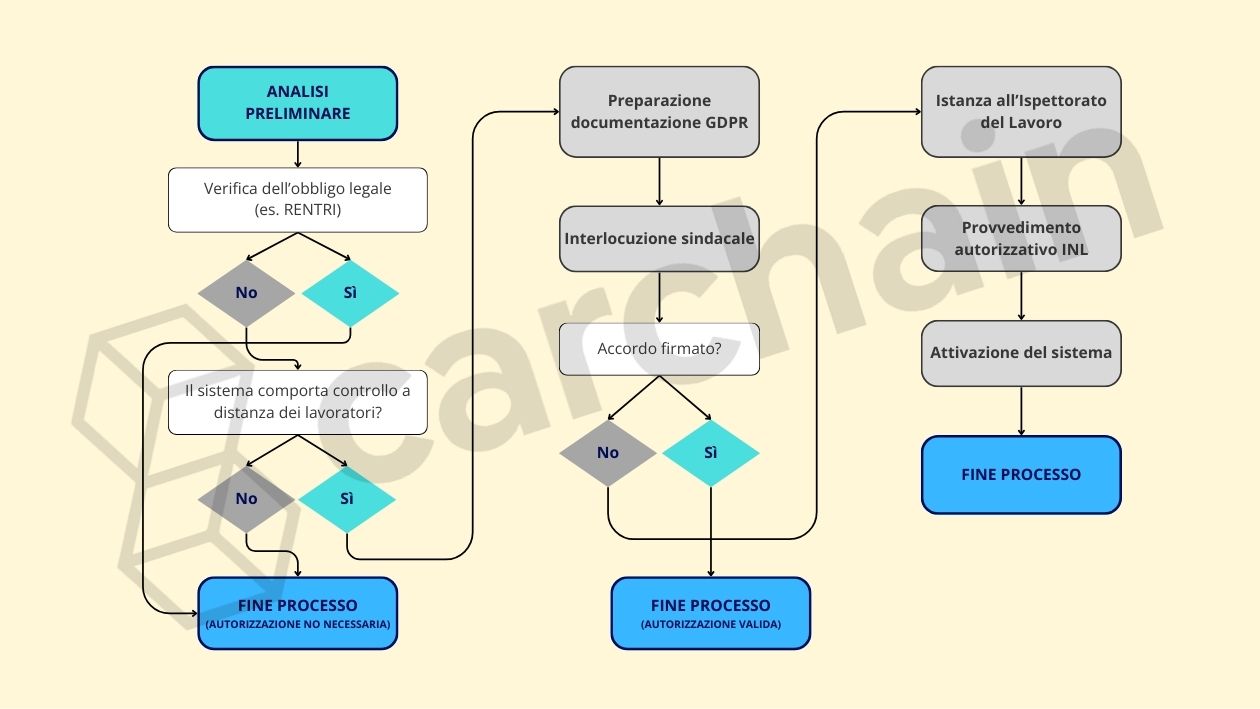
- Step 1 — Preliminary assessment
Evaluate if GPS is required by law and whether tracking enables remote monitoring of workers. - Step 2 — Prepare GDPR documentation
Define purpose, legal basis, retention time, security measures, employee rights and minimization policy. - Step 3 — Union agreement (if applicable)
If unions are present, negotiate an agreement. If not reached, proceed to INL request. - Step 4 — Request authorization from INL
INL evaluates and, if approved, authorizes activation of tracking.
Need to prepare documentation before installing GPS devices?
Generate a pre-installation technical and organizational report based on your proposed configuration. Use it as supporting documentation for internal review, union consultation, or labor inspectorate preparation.
Want the full PDF guide + GDPR templates for employees?
Get the essential templates to implement GPS tracking on company vehicles in line with Italian labour law and GDPR:
- Authorization workflow (BPMN)
- Art. 28 GDPR appointment template (Data Processor)
- Employee privacy notice (facsimile)
- Art. 30 GDPR record template (GPS tracking section)
Enter your email and we’ll send it instantly.
GDPR compliance checklist (required documents)
- Technical report of the GPS system
- GDPR information notice for employees (Art. 13 GDPR)
- Internal policy / corporate regulation on usage
- Data Processing Agreement with the provider (Art. 28 GDPR)
- DPIA (Data Protection Impact Assessment)
- Updated Record of Processing Activities (Art. 30 GDPR)
Common mistakes (risk of sanctions)
- Installing GPS without properly informing employees
- Using GPS outside working hours without rules
- Storing location data for too long
- Collecting overly detailed data (no minimization)
- Lack of DPIA in continuous tracking scenarios
- No agreement/INL authorization when required by Art. 4
Expert commentary: GPS in company vehicles without employee knowledge
Legal expert Avv. Angelo Greco explains key implications in this video:
Conclusion
GPS tracking on company vehicles in Italy is legal—but only if implemented correctly.
The correct approach is compliance first (Statuto dei Lavoratori + GDPR), then installation and activation.